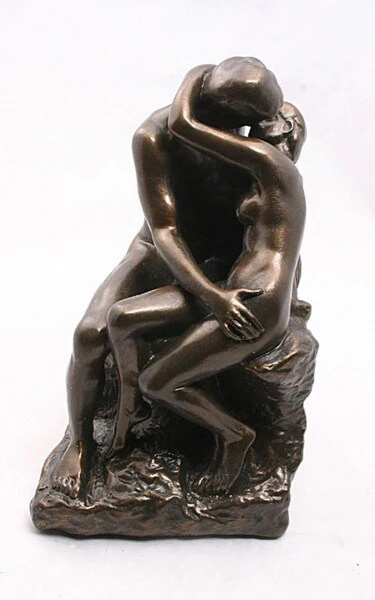
The Kiss By Rodin Bronze Finish 9" High
The Kiss by Rodin was acclaimed as a masterpiece when it was first exhibited in Paris in 1877 and even today it is still one of the most well-known and admired pieces of sculpture in the world. This statue originally represented Paolo and Francesca, two characters borrowed from Dante's Divine Comedy: slain by Francesca's husband, who surprised them as they exchanged their first kiss, the two lovers were condemned to wander eternally, through hell. Rodin was very talented at conveying feeling in his compositions by emphasizing gesture. Also, his rough surface texture with deep hollows added strong shadows and naturalism to the human form. Rodin's goal, as he put it, was to render inner feelings through muscular movement. He achieved this aim by joining his profound knowledge of anatomy and movement with special attention to the body's surfaces, saying that the sculptor must learn to reproduce the surface, which means all that vibrates on the surface, soul, love, passion, life … sculpture is thus the art of hollows and mounds, not of smoothness, or even polished planes.
Product Information
Product Information
Shipping & Returns
Shipping & Returns
Description
The Kiss by Rodin was acclaimed as a masterpiece when it was first exhibited in Paris in 1877 and even today it is still one of the most well-known and admired pieces of sculpture in the world. This statue originally represented Paolo and Francesca, two characters borrowed from Dante's Divine Comedy: slain by Francesca's husband, who surprised them as they exchanged their first kiss, the two lovers were condemned to wander eternally, through hell. Rodin was very talented at conveying feeling in his compositions by emphasizing gesture. Also, his rough surface texture with deep hollows added strong shadows and naturalism to the human form. Rodin's goal, as he put it, was to render inner feelings through muscular movement. He achieved this aim by joining his profound knowledge of anatomy and movement with special attention to the body's surfaces, saying that the sculptor must learn to reproduce the surface, which means all that vibrates on the surface, soul, love, passion, life … sculpture is thus the art of hollows and mounds, not of smoothness, or even polished planes.