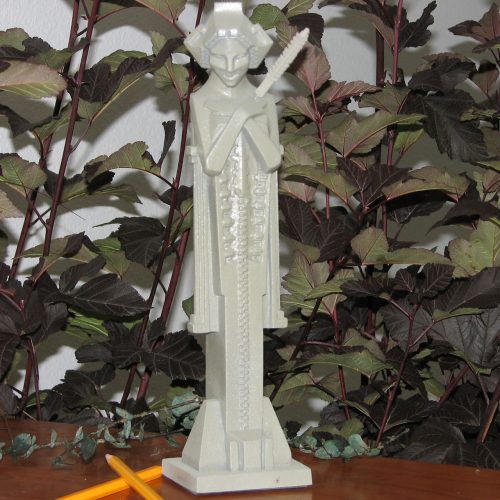
Frank Lloyd Wright Garden Sprite with Baton Desk Sculpture 12" High
Emerging from the visionary imagination of Frank Lloyd Wright, this 12-inch Garden Sprite with Baton captures the bold spirit and geometric elegance of one of America’s most influential architectural movements. Originally conceived for the legendary Midway Gardens in Chicago between 1913 and 1914, these stylized figures were designed to bring a sense of rhythm, unity, and human expression into Wright’s immersive architectural environment.
This tabletop sculpture is a faithful, authorized reproduction of the original full-scale figures created in collaboration with sculptor Alfonso Iannelli. Known for their striking abstraction and elongated forms, the sprites represent a fusion of architecture and sculpture—what Wright often described as “organic ornamentation.” The baton held across the chest suggests harmony, movement, and perhaps even a conductor of space itself, reinforcing Wright’s philosophy that design should orchestrate human experience.
Beautifully cast in durable stone, this piece offers a refined matte finish that highlights its crisp lines and intricate detailing. Its vertical presence and symmetrical form make it an exceptional accent for desks, shelves, or garden rooms, blending seamlessly into both modern and classical environments. Whether placed indoors or in a protected outdoor setting, this sculpture stands as a timeless tribute to early 20th-century innovation and artistic collaboration.
The Garden Sprites were originally installed at Midway Gardens, a revolutionary indoor-outdoor entertainment complex on Chicago’s South Side. Wright envisioned the space as a cultural hub where architecture, music, dining, and art merged into a unified experience. The sprites, positioned throughout the gardens, acted almost like silent performers—adding rhythm and personality to the environment.
Sadly, Midway Gardens was demolished in the 1920s, making surviving designs like this one even more meaningful. Today, these reproductions preserve a lost chapter of American architectural history and allow collectors to own a piece of Wright’s bold artistic legacy.
Product Information
Product Information
Shipping & Returns
Shipping & Returns
Description
Emerging from the visionary imagination of Frank Lloyd Wright, this 12-inch Garden Sprite with Baton captures the bold spirit and geometric elegance of one of America’s most influential architectural movements. Originally conceived for the legendary Midway Gardens in Chicago between 1913 and 1914, these stylized figures were designed to bring a sense of rhythm, unity, and human expression into Wright’s immersive architectural environment.
This tabletop sculpture is a faithful, authorized reproduction of the original full-scale figures created in collaboration with sculptor Alfonso Iannelli. Known for their striking abstraction and elongated forms, the sprites represent a fusion of architecture and sculpture—what Wright often described as “organic ornamentation.” The baton held across the chest suggests harmony, movement, and perhaps even a conductor of space itself, reinforcing Wright’s philosophy that design should orchestrate human experience.
Beautifully cast in durable stone, this piece offers a refined matte finish that highlights its crisp lines and intricate detailing. Its vertical presence and symmetrical form make it an exceptional accent for desks, shelves, or garden rooms, blending seamlessly into both modern and classical environments. Whether placed indoors or in a protected outdoor setting, this sculpture stands as a timeless tribute to early 20th-century innovation and artistic collaboration.
The Garden Sprites were originally installed at Midway Gardens, a revolutionary indoor-outdoor entertainment complex on Chicago’s South Side. Wright envisioned the space as a cultural hub where architecture, music, dining, and art merged into a unified experience. The sprites, positioned throughout the gardens, acted almost like silent performers—adding rhythm and personality to the environment.
Sadly, Midway Gardens was demolished in the 1920s, making surviving designs like this one even more meaningful. Today, these reproductions preserve a lost chapter of American architectural history and allow collectors to own a piece of Wright’s bold artistic legacy.